
Where to See Alpacas and Condors Near Cusco: Awanakancha & Cochahuasi
Quick Answer
Pariwana’s travel blog gathers articles for young travelers about Peru, Lima, Cusco, local culture, food, adventure, budget travel and practical tips.
Quick answer
Wondering where to see alpacas and Andean condors near Cusco? Visit Awanakancha and Cochahuasi, two places along the road to Pisac that you can easily combine in one trip. Awanakancha introduces you to South America's four camelid species and traditional Andean weaving. Cochahuasi is a wildlife sanctuary caring for rescued animals, including the spectacular Andean condor.
Key takeaways
Awanakancha is a living museum where you can learn about llamas, alpacas, vicuñas and guanacos, as well as traditional Andean textiles.
Cochahuasi Animal Sanctuary cares for rescued wildlife, including Andean condors and other native Peruvian species.
Both places are close together, at approximately kilometers 23 and 22 of the Cusco–Pisac road.
The experiences complement each other: Awanakancha focuses on camelids and living textile traditions, while Cochahuasi introduces visitors to wildlife rescue and conservation.
Cochahuasi also has a volunteer program, worth exploring if you're staying in Cusco longer and want to support animal care.
Meet Andean animals beyond the usual tourist photos
Think of Cusco, and you probably picture ancient Inca ruins, mountain landscapes and a llama standing beside someone wearing traditional Andean clothing.
But there's much more to Peru's wildlife than the classic llama photo.
Just outside Cusco, you can visit a place dedicated to all four South American camelids, discover how alpaca fiber becomes colorful traditional textiles, and then continue to a sanctuary caring for animals rescued from illegal trafficking and mistreatment.
The two places are called Awanakancha and Cochahuasi, and they are surprisingly close to each other.
If you're looking for things to do near Cusco beyond the usual archaeological sites, this is a rewarding way to spend part of your day. It's particularly appealing to backpackers, solo travelers, wildlife enthusiasts and anyone curious about the relationship between Andean culture and nature.
Awanakancha vs. Cochahuasi: what's the difference?
Although both places offer opportunities to observe animals, they serve different purposes.
| Awanakancha | Cochahuasi | |
|---|---|---|
| Type of place | Living museum and cultural center | Wildlife rescue sanctuary |
| Main attraction | Four South American camelid species | Andean condors and other rescued animals |
| Main focus | Traditional textiles and camelid knowledge | Animal welfare, rescue and conservation |
| Location | Km 23, Cusco–Pisac road | Km 22, Cusco–Pisac road |
| Best for | Culture, textiles and camelid enthusiasts | Wildlife lovers and conservation-minded travelers |
Visiting both provides a more complete experience than treating them as interchangeable attractions.
Awanakancha: where to see alpacas, llamas, vicuñas and guanacos in Cusco
Awanakancha, sometimes written as Awana Kancha or Awanacancha, is one of the most interesting places near Cusco to learn about South America's native camelids.
Located at kilometer 23 of the road to Pisac, it operates as a living museum combining animal observation with demonstrations of traditional Andean textile techniques.
The experience goes beyond meeting fluffy alpacas. You'll also learn why camelid fibers have played such an important role in the Andes and how local textile knowledge has been passed down through generations.
Meet the four South American camelids
One of Awanakancha's biggest attractions is the opportunity to learn the differences between four closely related but distinct animals.
1. Llama
The llama is probably the best-known Andean animal among international travelers.
Llamas are relatively large, with long necks and distinctive ears. They were domesticated thousands of years ago and traditionally played an important role as pack animals in the Andes.
2. Alpaca
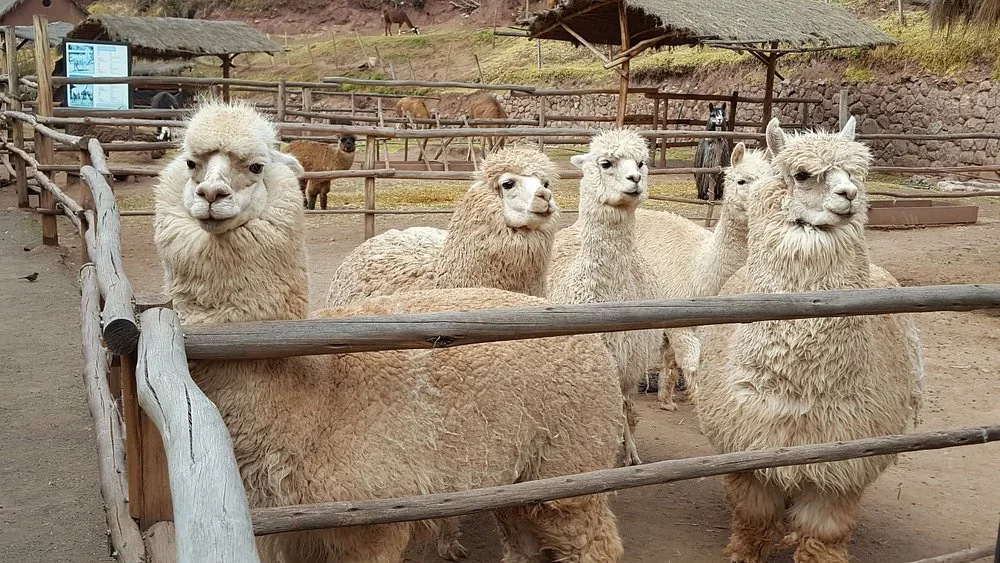
Usually smaller and woollier-looking than a llama, the alpaca is especially prized for its soft fiber.
Alpaca fiber is used to produce clothing, blankets and other textiles. At Awanakancha, you can learn about different types of alpacas and how their fiber is used.
3. Vicuña
The vicuña is a wild camelid with a slender build and remarkably fine fiber.
Unlike llamas and alpacas, vicuñas have not been domesticated. Protecting their populations and managing their valuable fiber responsibly are important conservation concerns in the Andes.
4. Guanaco
The guanaco is another wild species, closely related to the llama.
It has a more athletic appearance and generally brown fur with lighter areas. Because many visitors have never seen a guanaco before, it's often one of the most surprising animals at Awanakancha.
Seeing these four species and learning how to identify them makes the visit more educational than a typical animal photo stop.
Can you feed alpacas at Awanakancha?
Depending on staff instructions and the conditions of your visit, you may have the opportunity to feed some camelids with approved vegetation.
This can be a fun way to watch their behavior up close and take photos.
However, always follow the center's rules. Don't bring random food, chase animals or assume that every species can be approached.
The goal is to enjoy the encounter while respecting the animals' space and wellbeing.
Traditional Andean weaving: from fiber to finished textiles
Awanakancha is also an excellent introduction to the world of Andean weaving.
Here, you can learn how animal fibers are prepared, spun, dyed and woven into finished pieces.
One particularly interesting aspect is the use of natural dyes. Traditional textile makers use knowledge of plants, insects and other natural materials to produce a remarkable range of colors.
For example, cochineal has long been used to create red tones, while different plants can produce greens and yellows.
Watching a weaving demonstration gives you a greater appreciation of the patience and skill behind a traditional poncho, blanket or scarf.
It's also a reminder that Andean textiles are more than souvenirs. Their techniques, patterns and cultural meanings form part of a living heritage.
How does Awanakancha work with Andean communities?
According to Peru's official tourism platform, Awanakancha was founded in 2004 as a family initiative focused on promoting and preserving traditional Andean textile knowledge.
The project developed relationships with highland communities in the Cusco region, connecting camelid breeding and fiber production with textile craftsmanship.
Its educational purpose is one of the main reasons the place stands out.
When browsing its textile shop, ask about the fibers, weaving techniques and origin of the products that interest you.
Rather than assuming how much of each sale goes to individual artisans, it's better to learn directly about the makers and the center's community initiatives.
You can find more background in Peru's official tourism information about Awanakancha.
Cochahuasi Animal Sanctuary: meet rescued wildlife near Cusco
Just a short distance away, at kilometer 22 of the Cusco–Pisac road, you'll find Cochahuasi Animal Sanctuary.
Unlike Awanakancha, Cochahuasi is primarily focused on wildlife rescue and animal welfare.
The sanctuary cares for animals affected by illegal wildlife trafficking, captivity and mistreatment. Some arrive with injuries, while others have spent so much time around humans that returning to the wild becomes difficult.
The sanctuary describes providing species-appropriate diets, veterinary attention, enclosure maintenance and environmental enrichment.
Its broader mission also includes educating visitors about wildlife conservation.
Why the Andean condor is the highlight
For many visitors, the most memorable experience at Cochahuasi is seeing an Andean condor.
The Andean condor, scientifically known as Vultur gryphus, is one of the world's largest flying birds and an iconic species of the Andes.
Its wingspan is extraordinary. Seeing this bird spread its wings up close gives you a completely different sense of its size compared with photographs.
Cochahuasi has worked with condors affected by injuries and captivity. Its conservation initiatives include rehabilitation efforts and, where conditions permit, release back into the wild.
The sanctuary has also documented a condor release involving GPS tracking.
During some visits, it's possible to observe a condor in flight or with its wings fully extended. However, a flight demonstration should never be treated as guaranteed.
The animals' health and wellbeing must come first, and any opportunity to see a condor fly depends on the sanctuary's current practices.
What makes the visit meaningful isn't simply watching a spectacular bird. It's understanding why these animals need protection.
What other animals can you see at Cochahuasi?
While the condors are a major attraction, Cochahuasi's work extends to other rescued animals.
The sanctuary has shared information about wildlife such as macaws, tortoises and additional native species, including animals from different Peruvian ecosystems.
Some may have been kept illegally as pets or used for entertainment. Others arrive with physical damage that requires ongoing care.
A guided visit can help you understand individual rescue stories and the challenges involved in rehabilitating wildlife.
Keep in mind that the species present and the animals available for observation may change. Rescues, treatments and releases can all affect what visitors see.
Why can't every rescued animal return to the wild?
Rescuing a wild animal is often only the beginning.
An animal that has lived in captivity for years may have lost essential survival skills. Others may have permanent injuries that prevent them from finding food, avoiding danger or moving normally.
Releasing such an animal without assessing its condition could put it at serious risk.
That's why responsible rehabilitation involves veterinary assessments, appropriate habitats and decisions based on each animal's needs.
For animals that cannot safely return to nature, long-term care may be the most humane option.
At Cochahuasi, this reality becomes easier to understand because visitors can learn about the stories behind the animals.
It's also a useful reminder to avoid tourist activities involving wildlife exploitation, inappropriate handling or animals being used purely as photo props.
Can you volunteer at Cochahuasi Animal Sanctuary?
Yes. Cochahuasi offers a wildlife rescue volunteer experience for people interested in supporting its work.
The program is especially relevant for backpackers staying in Cusco for a longer period, students and travelers seeking a more involved conservation experience.
According to its official website, volunteers may assist with:
Preparing and distributing food under staff supervision.
Cleaning animal areas and maintaining enclosures.
Environmental cleanup around the sanctuary.
Animal enrichment activities.
Visitor education and interpretation.
Reforestation or habitat improvement projects when approved.
The activities depend on the sanctuary's operational needs and management guidelines.
Volunteering doesn't mean unrestricted contact with wild animals, and it's important to follow all safety and welfare procedures.
Interested in applying?
Visit the official Cochahuasi volunteer program or contact the sanctuary directly:
Email: info@cochahuasi.com
Phone: +51 984 600 380
Check current availability, costs, booking conditions and requirements before making plans.
How to visit Awanakancha and Cochahuasi on the same trip
One of the biggest advantages of these two places is how close they are to each other.
Both are located along the route between Cusco and Pisac, making them convenient to combine without allocating separate days.
Where are they located?
Cochahuasi is at approximately kilometer 22 of the Cusco–Pisac road, while Awanakancha is at kilometer 23.
The drive from central Cusco generally takes around half an hour, although traffic and road conditions may affect your journey.
Because they're only a short distance apart, visiting them consecutively makes sense.
Getting there from Cusco
Taxi or private driver
This is a convenient option for travelers who want to control their itinerary.
You can arrange for a driver to take you to both places and return to Cusco or continue to Pisac afterward.
If you're traveling with friends, sharing a vehicle may also make the logistics easier.
Agree on the route, waiting arrangements and total fare before leaving.
Local transport toward Pisac
You can also investigate local transport options heading toward Pisac.
Cochahuasi's official website mentions buses departing from the Puputi Street area in Cusco.
Ask the driver where to get off and how to arrange your return. Don't assume that transport will always be immediately available.
Although the two attractions are nearby, check road and pedestrian conditions before deciding to walk between them.
Suggested half-day itinerary
Here's a simple way to organize the trip.
Stop 1: Cochahuasi Animal Sanctuary
Start with the rescued animals and learn about the sanctuary's work.
Take your time listening to the guides, especially when they explain individual rescue stories and the challenges of animal rehabilitation.
Stop 2: Awanakancha
Continue to the camelid and textile center.
Meet the four species, learn how to distinguish them and explore traditional spinning, dyeing and weaving techniques.
After the visits
Return to Cusco or continue toward Pisac if you want to explore more of the Sacred Valley.
If you're planning a longer itinerary, our backpacker's guide to Machu Picchu and the Sacred Valley offers more ideas for exploring the region.
How much time should you allow?
If you only plan to visit Awanakancha and Cochahuasi, setting aside a morning or a substantial part of the day is a sensible starting point.
The exact duration will depend on transport, tour arrangements and how much time you spend at each center.
If you enjoy talking to guides, photographing animals responsibly or watching weaving demonstrations, avoid packing the itinerary too tightly.
Add more time if you're continuing to Pisac.
Practical backpacker tips
Bring water and sunscreen. The Andean sun can be strong, even on cool days.
Dress in layers. Temperatures and weather conditions can change during the day.
Carry some cash. It can be useful for local transportation and small purchases.
Check visiting arrangements in advance. Admission conditions, schedules and prices may change.
Respect the animals. Never touch, chase or feed them without permission.
Ask before photographing artisans up close. A respectful exchange is better than treating people as part of a display.
Don't rush the experience. The best moments often come from listening and learning.
If you've just arrived in Cusco from a much lower altitude, remember to pace yourself while adjusting to the mountain environment.
Are Awanakancha and Cochahuasi worth visiting?
For travelers interested in animals, conservation and Andean culture, absolutely.
Awanakancha offers a chance to learn about all four South American camelids and see how traditional textile practices connect people, animals and highland communities.
Cochahuasi provides a different experience, centered on rescued wildlife and the responsibilities involved in caring for animals that have suffered human exploitation.
Together, they create an interesting alternative to spending every day visiting archaeological sites or joining high-altitude hikes.
They also encourage a more thoughtful approach to wildlife tourism.
An ethical animal encounter isn't defined by how close you can get for a photo. Animal welfare, the quality of care and the educational value of the visit matter much more.
Explore Cusco from Pariwana Hostel
Staying in central Cusco makes it easier to use the city as your base for exploring the surrounding region.
If you're looking for a hostel in Cusco with a social atmosphere, Pariwana Hostel Cusco near Plaza de Armas is a convenient place to start.
Located at Calle Quera 270 in the Historic Center, Pariwana offers shared dorms, private rooms, common areas, daily activities and a tour desk.
It's a good base for planning daytime adventures while also meeting other travelers.
After your visit to Awanakancha and Cochahuasi, you can return to the city, relax and share your discoveries with fellow backpackers.
For more ideas before your trip, explore our Cusco travel guide for backpackers.
Frequently asked questions
Where can I see alpacas, llamas, vicuñas and guanacos near Cusco?
Awanakancha, at kilometer 23 of the Cusco–Pisac road, is a living museum dedicated to all four South American camelids. Visitors can learn about the animals and their connection to traditional Andean textiles.
Can I visit Awanakancha and Cochahuasi in one day?
Yes. Cochahuasi is at approximately kilometer 22 and Awanakancha at kilometer 23 of the same road. You can easily plan a combined visit, provided you confirm current access arrangements and transportation.
How do I get to Awanakancha and Cochahuasi from Cusco?
A taxi or private driver is a convenient option. Local transport toward Pisac is another possibility, with services mentioned by Cochahuasi departing from the Puputi Street area. Check your return arrangements before leaving.
What rescued animals can I see at Cochahuasi?
Cochahuasi is especially known for its Andean condors. The sanctuary has also cared for macaws, tortoises and other native animals. Species available for observation may change according to rescue and rehabilitation needs.
Can I watch an Andean condor fly at Cochahuasi?
A condor may sometimes be seen in flight, but this is not guaranteed. The experience depends on the sanctuary's activities and the condition of the animals. Visitors should prioritize learning about conservation over expecting a specific display.
Can I volunteer at Cochahuasi Animal Sanctuary?
Yes. The sanctuary offers a volunteer program involving supervised animal care support, cleaning, environmental activities and visitor education. Contact info@cochahuasi.com or consult its official volunteer page for current requirements and availability.
Sources checked
Reviewed November 2, 2026.
Peru.travel — Awanacancha. Official tourism information covering camelids, weaving traditions and the cultural center.
PromPerú — Awanakancha and Andean textile heritage. Background on the center's origins and community relationships.
Cochahuasi Animal Sanctuary. Official information about wildlife rescue, animal welfare, conservation and location.
Cochahuasi Volunteer Program. Official information about supervised activities and how to contact the sanctuary; linked in the volunteering section above.
Travel note: Animal species, visiting conditions, opening times, admission fees and volunteering opportunities may change. Confirm details directly with each organization before visiting.
✍️ Pariwana Editorial Team
Practical travel tips written by backpackers, for backpackers.

A practical guide for travelers visiting Humantay Lagoon from Cusco, including altitude tips, hiking difficulty, best season and what to expect.
