

Cusco Historic Center: backpacker guide, photo spots and local history
There are cities you enjoy, cities that surprise you, and cities that make you feel like you are walking through a movie. Cusco’s Historic Center belongs to that third category. You step outside thinking you are just going for a short walk, and before you know it, you are surrounded by flawless Inca stonework, massive colonial churches, steep cobbled streets, musicians, artisans, travelers speaking half a dozen languages, and an energy that is hard to explain until you feel it for yourself. It is not just a beautiful place. It is one of those destinations that asks you to explore with your eyes, your legs, and your curiosity fully switched on.
For young travelers, backpackers, and adventurous spirits, the Cusco Historic Center has an almost addictive quality. You can explore it on foot, it has history in every corner, it gives you incredible photos without needing a perfect setup, and it mixes monumental landmarks with real everyday life. In the same hour, you can step inside a temple that once played a major role in the Andean world, grab a coffee overlooking old rooftops, hear English, Portuguese, Spanish, and French at the next table, and end the day watching the sky turn gold over the domes of the city. If you are planning your route through Peru and wondering where that intense mix of past and present feels strongest, here is the honest answer: in the Cusco Historic Center.
The city was recognized as a World Heritage Site by UNESCO, and it is easy to understand why. Here, urban design, stone walls, temples, plazas, and streets tell a very long story: the story of the capital of the Tahuantinsuyo, the colonial transformation that followed, and a city that still welcomes visitors from all over the world without losing its identity. According to the official Peru.travel page on Cusco’s Historic Center, this is the kind of place where you can spend hours walking between churches, museums, balconies, stone alleys, and character-filled neighborhoods without ever feeling bored.
That is exactly what makes Cusco so special for backpackers. You do not need to spend a fortune to feel like you are having a huge travel experience. All you need is time, comfortable shoes, a bottle of water, some phone battery, and a willingness to walk slowly. If you also stay somewhere social, well located, and designed for meeting other travelers, choosing the right hostel in Cusco can completely change your trip, because this city is not just visited. It is shared.
The first thing you notice: altitude, energy, and a city that refuses to be summarized
There is one truth every traveler learns quickly in Cusco: this is not a city to rush on your first day. The altitude changes everything, which means the Historic Center is much more enjoyable when you accept the local rhythm and understand that the goal is not to beat the hills, but to let the city set the pace. That is also one of Cusco’s first backpacker lessons: slow down, look harder, and give yourself permission to notice details.
The Historic Center does not work like those old town districts you visit in an hour and then check off your list. Cusco does the opposite. You begin at Plaza de Armas, and from there the city opens up as if every street had its own personality. One street leads you to a famous stone that seems to challenge modern engineering. Another leaves you standing in front of a huge church. Another climbs toward workshops, balconies, and viewpoints where the city becomes even more photogenic. Another pushes you toward a market where the tourist postcard vibe fades and something more daily, more flavorful, and more real takes over.
What makes it even better is that the atmosphere changes throughout the day. In the morning, the Historic Center feels calmer, with cleaner light, quieter streets, and groups just beginning their walking tours. By midday, everything becomes more active. Plazas fill up, bells ring, courtyards come alive, and the city feels unmistakably international. In the afternoon, when the sunlight hits the facades and rooftops, everything becomes more cinematic. At night, the center changes mood again. It is still historical, but now it also feels social, perfect for a long dinner, a beer, a conversation with other travelers, or one of those improvised plans that somehow becomes one of the best memories of the trip.
One important thing: here, history is not locked inside a museum
That may be the most fun thing about the Cusco Historic Center: you do not have to step into a museum to feel its history. History is literally out in the street. It is in the stone walls that survived centuries, in the urban layout that still reveals the logic of the Andean world, in the names of the streets, in churches built on top of Inca foundations, and in the feeling that one layer of time never fully erased the previous one.
The UNESCO entry for the City of Cusco highlights exactly that unique condition: an Andean city of enormous historical and urban value, redesigned during the time of Pachacutec and later transformed after the conquest, yet still shaped by its original foundations. In traveler terms, that means something simple but powerful: you walk for five minutes and feel the weight of centuries, but in a way that feels direct and alive rather than academic.
For young travelers, this makes the Historic Center not just cultural, but genuinely entertaining. You do not have to show up in full history-class mode. You can explore it with the same excitement you feel when looking for a viewpoint, a good photo, or a street with great atmosphere. Cusco rewards that mixed kind of curiosity, the kind that wants to understand and the kind that simply wants to feel the destination.
Plaza de Armas: the heart of the city and the place you keep returning to
Almost everything in the Cusco Historic Center connects back to Plaza de Armas sooner or later, and that makes perfect sense. It is not just the city’s most famous square. It is the place where the trip starts making sense. From here, it is easy to orient yourself, begin a walking route, meet people from your hostel, take a break, watch the movement of the city, or simply sit for a while and see how the whole world flows around you.
The square has that rare ability to feel monumental and approachable at the same time. On one hand, it is framed by impressive buildings, churches, balconies, and arcades that remind you of the city’s historical scale. On the other hand, it is full of daily movement: people chatting, travelers taking pictures, street performers, guides gathering groups, and a constant flow of life that makes the space feel vibrant rather than frozen in time. If you are traveling solo, this is one of those places where you never feel completely alone. There is always something happening.
Another fun detail is that Plaza de Armas is not just a postcard stop. It is also one of the clearest expressions of Cusco’s multicultural atmosphere. In just a few minutes, you can hear Spanish, English, Portuguese, German, and Italian, and see everyone from budget backpackers to travelers celebrating the biggest trip of their lives. That international mix is part of the charm of Cusco’s Historic Center. It gives the city movement, crossing storylines, and a backpacker-friendly sense of community that is easy to love.
And if you are into photography, the square changes constantly with the light. Early in the morning, it offers cleaner shots, softer tones, and fewer people. At sunset, the facades gain texture and warmth. At night, with the lights on, it feels more dramatic and elegant. This is not the kind of place you photograph once and forget. It is the kind of square you return to because it never looks exactly the same twice.
Qorikancha: one of those places where the past still feels heavy
If there is one site in the Historic Center where you truly feel the symbolic force of ancient Cusco, it is Qorikancha. Both the official Peru.travel page on Cusco’s Historic Center and the page dedicated to the Temple of the Sun, Qorikancha present it as one of the city’s must-see places, and that is not an exaggeration.
Visiting Qorikancha is one of those moments when even the most relaxed traveler suddenly becomes more attentive. First, because the site carries enormous historical meaning. Second, because it captures the overlapping worlds that define Cusco: Inca walls of extraordinary technical precision and the later colonial presence built above them. It is the kind of setting where nobody needs to tell you, “this matters.” You feel it immediately.
For young travelers, Qorikancha has another advantage. It is not just a place to admire and leave behind. It also helps you understand everything else you will see later in the Historic Center. Once you have been here, many streets, plazas, and stories around Cusco begin to connect more clearly. The city stops being simply beautiful and starts becoming readable.
A useful tip is not to rush through this visit. It is worth taking time to look at the textures, contrasts, and layers, then heading back outside to wander slowly around the surrounding streets. If you want more context, it is a good idea to check the official Cusco museums information in advance, because museum visits can add a lot to the experience.
The Twelve-Angled Stone: yes, it is famous, but the amazement is real
There are places travelers worry will feel too touristy, too photographed, or too hyped by Instagram. The Twelve-Angled Stone sounds like it might fall into that category, right up until you actually stand in front of it. Yes, it is famous. Yes, there are often people around. Yes, everyone wants a photo. But it is also true that when you see it in person, it is genuinely impressive.
It is not impressive because it is huge or isolated in a dramatic landscape. It is impressive because of its precision, its technique, its durability, and its context. It is simply there, built into the city, as a visible example of the level reached by Inca engineering. That makes it a short stop, but a powerful one. It is one of those physical proofs that the Cusco Historic Center does not just talk about history. It displays it right in front of anyone willing to stop and look.
Hatun Rumiyoc Street, where the stone is located, deserves more time than many people give it. Do not go only for the quick photo. Walk slowly, study the walls, feel the slope under your feet, and notice how the details shift from one facade to another. In a very short stretch, you get an absurd amount of identity and atmosphere. For travel content, urban photography, or simply for understanding why Cusco feels so different from other cities in Latin America, this place matters.
San Blas: the neighborhood that feels made for getting lost on purpose
If Plaza de Armas is the heart of the Historic Center, San Blas is its bohemian, creative, and quietly magical side. The official Peru.travel page on San Blas describes it as the traditional neighborhood of Cusco’s artisans, full of narrow, steep streets and colonial houses. That is all true. But the best part of San Blas never fits neatly inside a description. You have to walk it.
San Blas is the kind of neighborhood that forces you to slow down, even if you were not planning to. The streets are narrow, the uphill sections make themselves known, and in almost every block there is something that catches your eye: an old doorway, a balcony, an art shop, a stone wall, a hidden courtyard, an unexpected view. It has the kind of atmosphere that feels genuinely alive rather than polished just for visitors.
For young travelers, San Blas offers one of the best balances in Cusco. It is highly photogenic without feeling artificial. It is perfect for taking photos, but also for sitting down, browsing small workshops, buying something simple, grabbing a coffee, and watching local life blend with travelers from around the world. The multicultural side of Cusco becomes especially visible here: couples, solo travelers, groups of friends, artists, students, and people laughing halfway up the hill because the altitude is winning for the moment.
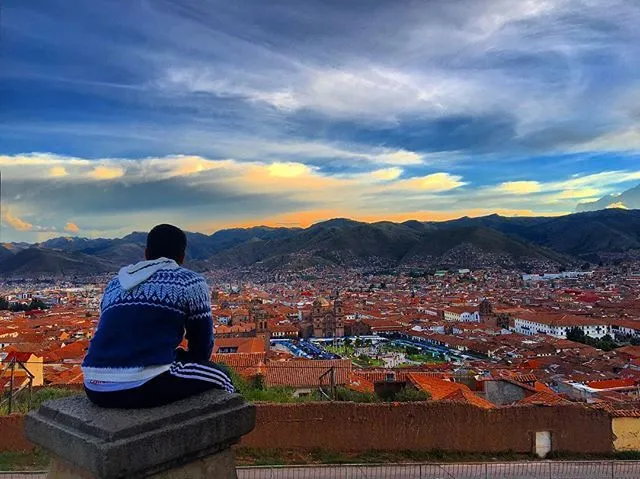
And yes, this is one of the best photo zones in the city. If you want those rooftop shots with domes, narrow streets, layers of buildings, and a city stretching across the slopes, San Blas makes it easy. Sunset up here is especially good. The light spills over the rooftops, and the whole city turns into a mix of terracotta, gold, and blue shadow. You do not need to be a pro photographer to leave with memorable images.
The Cathedral and the churches of the center: even non-religious travelers enjoy this stop
Some travelers tend to skip churches because they assume they will all feel similar. In Cusco, it is worth dropping that idea. The official Peru.travel page on Cusco Cathedral shows why it is much more than just a large church facing the square. It is also one of the clearest ways to understand how the cultural landscape of the Historic Center was built.
Even if religious art is not usually your thing, entering can still be worth it for three reasons. First: architecture. Second: history. Third: contrast. Cusco is a city where every major religious building forces you to think about what was there before, what changed, and how one culture imposed itself over another without fully erasing what came first. That makes the experience richer and more complex in the best way.
The backpacker recommendation here is simple: do not try to see every church in checklist mode. Pick one or two important ones, step inside slowly, and pay attention to details. Look at ceilings, stonework, altars, paintings, courtyards, and materials. Sometimes a short, attentive visit gives you much more than twenty rushed stops.
San Pedro Market: the moment Cusco starts feeling even more real
Many travelers associate the Cusco Historic Center only with churches, plazas, and Inca stonework, but San Pedro Market adds another layer to the experience: the daily one, the flavorful one, the version of the city that smells like juice, bread, herbs, fruit, soups, textiles, and movement.
Going to the market is a great plan for backpackers because it breaks up the monumental part of the route and connects you with a different kind of energy. Here, the star is not the perfect facade, but everyday life. You can have breakfast, eat a simple lunch, browse Andean products, buy a snack before continuing your walk, or just wander through the aisles and feel the local rhythm.
The market also balances your experience of Cusco. Yes, the city is visually stunning, but it is also a living city, with routines, daily commerce, and an identity that does not begin or end with its iconic landmarks. For young travelers, that always makes a destination richer. You do not leave only with the beautiful photo. You also leave with scenes, sounds, smells, and conversations.
The best photo spots in Cusco Historic Center
If your phone is always ready when you travel, Cusco’s Historic Center will give you more than enough material. But instead of just hunting for the obvious image, it helps to think in terms of different kinds of photos.
The first is the monumental shot, and Plaza de Armas still wins that category easily. It works in daylight, at sunset, and after dark. The second is the texture-and-history photo: Inca walls, cobbled streets, old doors, architectural details, and corners where the city reveals its age. For that, Hatun Rumiyoc and the surrounding streets are perfect. The third is the urban panoramic shot, which San Blas delivers beautifully, especially when the sky is clear and the late light starts dropping over the rooftops. The fourth is the image full of local color and movement, and for that, San Pedro Market contributes a lot.
My backpacker tip here is simple: do not get obsessed with recreating the exact viral photo you saw before the trip. Cusco rewards observant walking much more than photo-copying the same angle everyone already knows. Look up, turn down a random street, climb one more block, return to the same square at another hour. Very often, the best photo of the trip comes from one of those unplanned moments when you were simply paying attention.
The multicultural atmosphere: one of the best parts of the whole experience
Cusco has welcomed visitors from all over the world for years, but in the Historic Center that diversity feels especially strong. And for backpackers and solo travelers, that is a gift. Not only because it makes it easier to meet people, but because it turns each day into a mix of stories, routes, languages, and personalities.
There is something special about having breakfast near the plaza and overhearing one couple plan Machu Picchu, a group of Brazilians compare tour prices, someone ask about the Sacred Valley, another traveler look for a good place to work for a few hours, and someone else admit they came for three days and somehow stayed for a week. The Cusco Historic Center is full of that kind of energy: changing plans, extended stays, spontaneous friendships, and the constant sense that something is always happening.
That is why where you stay matters. A social place with a great location and real activities can turn a beautiful city into an unforgettable experience. If you want that sense of community, check the Pariwana Cusco activity lineup, because many of the best travel moments do not begin with a formal tour. They begin with a casual conversation that turns into a walk, a group dinner, a night out, or a shared plan for the next morning.
How to explore the Historic Center without exhausting yourself or feeling like you missed everything
One of the most common mistakes in Cusco is trying to see everything too fast. Bad plan. The best way to experience the Historic Center is to organize it by rhythm rather than anxiety.
A good first block can begin at Plaza de Armas, continue to the Cathedral, move toward Hatun Rumiyoc, and then climb to San Blas. Take breaks, drink water, and do not turn the morning into a race. Later you can come back down, have lunch, and leave Qorikancha, San Pedro, or a nearby museum for the afternoon or the next day.
If you like having a travel reference before arriving, the Cusco travel guide for travelers helps organize areas, timing, and expectations. And if you are still shaping your full route, the Backpacker’s Guide to Peru is useful for understanding how Cusco fits into a wider trip around the country.
Another genuinely helpful detail is grabbing free maps. In a city like Cusco that might sound minor, but it helps a lot. Not because you are likely to get seriously lost, but because knowing where you are gives you more confidence to improvise. And in the Historic Center, well-guided improvisation often leads to the best moments.
Interesting and fun facts that make the walk even better
First: the Cusco Historic Center matters not only because it is beautiful, but because it was one of the most powerful urban spaces in the Andean world. Second: its value does not come from a single monument, but from the relationship between plazas, neighborhoods, churches, streets, and surviving Inca foundations. Third: walking through it is one of the best ways to understand how the Inca past and the colonial period became physically intertwined.
Fourth: some of the most memorable things in the Historic Center are not necessarily the largest or most famous, but the most unexpected. A staircase, a narrow lane, a high viewpoint, a blue door against an old stone wall, a small corner that suddenly looks cinematic. Fifth: San Blas is not just pretty. It is one of the best places to feel Cusco’s artistic side. You notice it in the workshops, the handmade details, the little galleries, and the storefronts that make the neighborhood feel creative and alive.
Sixth: the historical route does not end in the center. Many travelers use this area as their base before moving on to other major places in the region. If your trip continues, the Backpacker Guide to Machu Picchu and the Sacred Valley is a helpful next step, because lots of travelers combine a few urban days in Cusco with more intense outings toward archaeological sites and high-altitude landscapes.
Seventh: if your route started in the capital and you are still comparing city energies, Peru changes dramatically from one destination to the next. The contrast between coast and highlands is strong, which is why combining a hostel in Lima with your Cusco stay can make the trip feel far more complete: first ocean, urban food, and coastal chaos; then altitude, stone, history, and mountains.
Eighth: Cusco does not force you to choose between culture and fun. You can have a deeply historical day and still finish it with a social plan. That combination is a big reason why so many young travelers connect with the city so quickly.
Is walking enough, or should you also visit museums?
The honest answer is: it depends on your style, but ideally you should do both. Walking is essential because the Cusco Historic Center makes sense through movement, scale, and physical presence. But entering one or two cultural spaces helps you interpret what you have already seen outside.
If you want to check circuits and tickets, the most useful reference is the official COSITUC website, where you can review what is included in the Cusco Tourist Ticket and plan your visits more intelligently. That helps you avoid paying badly, improvising without information, or showing up at a site without knowing whether it belongs to the circuit that makes the most sense for your trip.
You do not need to turn your travels into a full museum marathon. Sometimes one well-chosen museum and one great walk are enough to make the Historic Center feel much richer. The key is balance: a little context, a little street time, a little rest, and a little improvisation.
Backpacker tips to enjoy more and spend smarter
First: give your body time to adapt. Altitude changes the trip, especially on day one. Second: start early at least one morning. Seeing the Historic Center before it gets busy has a lot of charm and usually gives you better photos too. Third: carry a light jacket even if the sun looks strong, because the weather changes quickly. Fourth: do not underestimate the value of good shoes. The stone streets and steep slopes are very real.
Fifth: do not try to check off every famous attraction in one day. Cusco becomes more enjoyable when you revisit places at different times. Sixth: combine major landmarks with simple moments. A market, a bench in the square, an unnamed street, a rooftop view. Sometimes those become more memorable than the big monument itself. Seventh: ask about events, activities, and social plans. Some of the best travel stories begin outside the classic itinerary.
And eighth: travel with respect. The Cusco Historic Center is not a movie set or a themed backdrop. It is a living city, with fragile heritage, residents, memory, and a strong identity. Truly enjoying it also means helping protect it: do not touch what should not be touched, do not leave trash behind, do not block narrow streets for one photo, and remember that being a responsible traveler always makes you a better traveler.
So what makes Cusco Historic Center so special for young travelers?
It offers almost everything without feeling fake. It carries real historical weight, but it never feels boring. It looks incredible, but it is not only about the photo. It has daily local life, but also a huge international travel community. It has quiet corners and lively plazas. It has culture, architecture, food, art, hills, markets, churches, viewpoints, and a global energy that makes it easy to slip into exploration mode.
The Cusco Historic Center works especially well for backpackers because it leaves room for different ways of traveling. You can do it in full history mode, full photo mode, full social mode, or some mix of all three. You can spend little and still experience a lot. You can stick to a plan or improvise freely. You can walk alone or make new friends along the way. Most importantly, it offers something deeper than a list of “things to do in Cusco.” It offers atmosphere. It offers layers. It offers memory.
That is why, when someone asks what to do in Cusco besides stacking tours one after another, the answer should always include this: walk the Historic Center slowly. Not as a formality before Machu Picchu, but as one of the main experiences of the trip. Because here you do not just understand the city better. You understand the journey better too.
And yes, you will come back with incredible photos. But you will probably return with something harder to explain as well: the feeling of having been somewhere the past is not standing still, where the stones still tell stories, and where it always seems like someone, somewhere around the corner, is just starting a new adventure.
✍️ Pariwana Editorial Team
Practical travel tips written by backpackers, for backpackers.
A practical backpacker guide to Cusco’s weather, seasons, altitude and temperatures